Michael Wilson · United States Air Force · 1981–1985
Service in the
invisible battlespace.
A personal tribute to service, vigilance, and the Airmen of Electronic Security Command—preserving the history of electronic warfare during the final decade of the Cold War.
WATCHING THE SPECTRUM
01 / MY SERVICE
Four years with a mission few people could see.
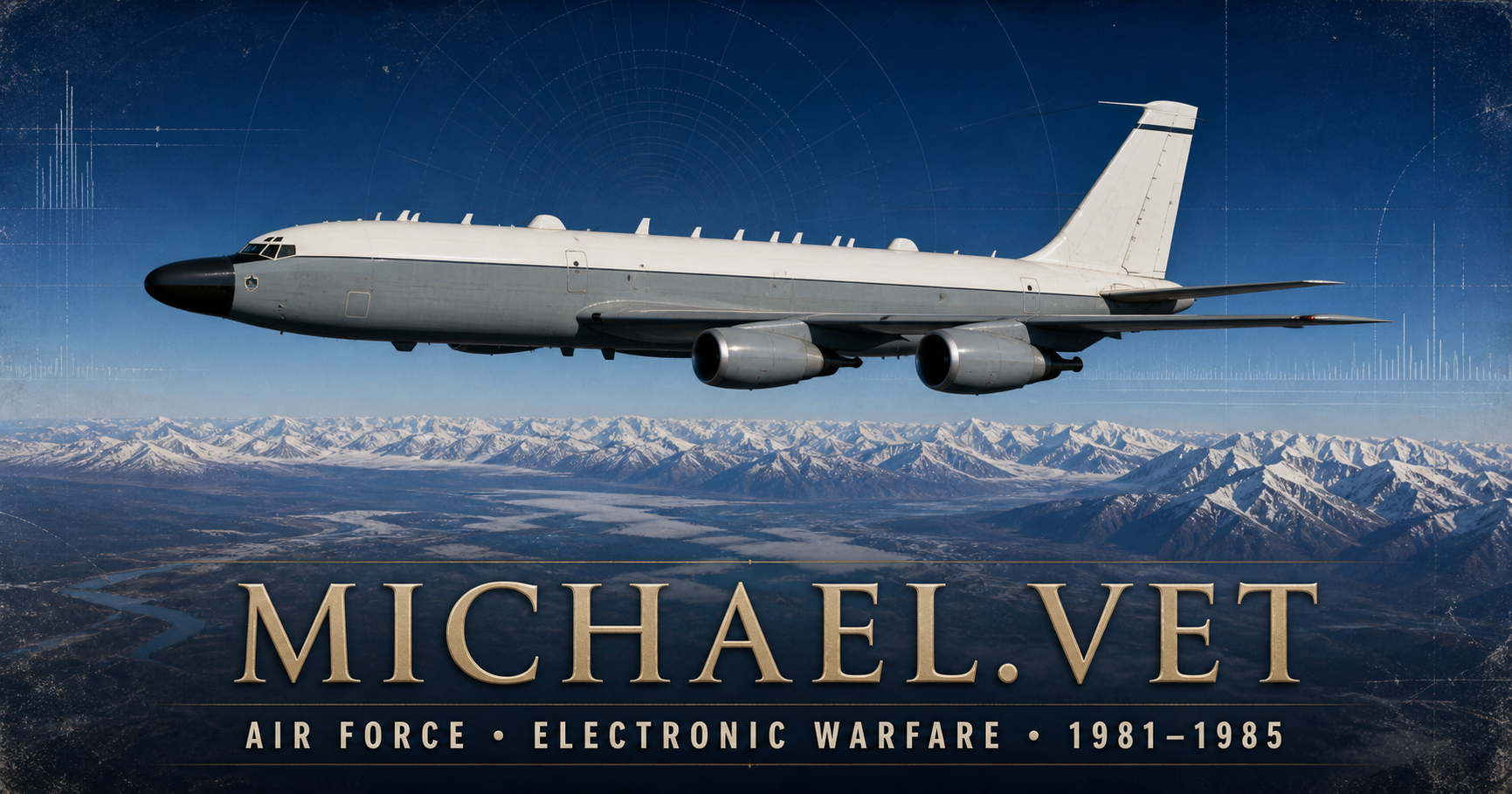
From 1981 to 1985, I served in the United States Air Force as a Sergeant (E-4), AFSC 32833—an Electronic Warfare System Specialist at Eielson Air Force Base, Alaska, under Electronic Security Command. It was a mission built on disciplined attention: listening, interpreting, and helping protect the force in a world shaped by Cold War tension.
This site honors the people who stood watch, the technology that changed modern warfare, and the enduring Air Force values carried forward long after active service.
Part of my mission was airborne. I flew aboard RC-135V/W Rivet Joint reconnaissance aircraft, listening to telephone communications as part of the airborne electronic warfare mission.
- Name
- Michael Wilson
- Rank
- Sergeant (E-4)
- AFSC
- 32833
- Specialty
- Electronic Warfare System Specialist
- Station
- Eielson AFB, Alaska
- Aircraft
- RC-135V/W Rivet Joint
- Airborne Mission
- Communications monitoring · Public, declassified history
- Service
- 1981–1985
02 / COLD WAR CONTEXT
Standing watch under the shadow of nuclear war.
I served from 1981 to 1985, during one of the tensest passages of the late Cold War. The possibility of a superpower confrontation was not an abstraction; it shaped the mission, the training, and the vigilance expected every day.
When my service began, Leonid Brezhnev led the Soviet Union from the Kremlin and Ronald Reagan had entered the White House. From Moscow and Washington came accusations, counterthreats, and stark warnings about nuclear war. Both governments maintained enormous arsenals while seeking advantage, deterrence, and—at the same time—negotiated limits on those weapons.
The strategic logic was commonly called mutually assured destruction, or MAD: neither side could launch a nuclear attack without facing a devastating retaliatory strike. Peace depended on readiness, communication, and the sobering knowledge that miscalculation could bring catastrophe to both nations.
My years of active-duty Air Force service.
Deterrence through the certainty of devastating retaliation.
U.S.–Soviet relations reached a low point during my service.
03 / COMMAND HISTORY
The Electronic Security Command era
ESC carried forward the Air Force’s signals intelligence heritage while expanding its electronic warfare mission.
- 1948
The United States Air Force Security Service begins its intelligence mission.
- 1979
The organization is redesignated Electronic Security Command.
- 1981–85
Michael Wilson serves as an Electronic Warfare System Specialist at Eielson AFB, Alaska.
- 1991
ESC is redesignated Air Force Intelligence Command.
HISTORY SOURCES
Historical dates, Cold War context, and lineage are drawn from official U.S. government sources.
ELSEWHERE ONLINE
More from Michael Wilson.
CONTACT